Should your lip gloss bottle feel weighty and luxurious or light and travel-friendly? This question forces a brand to weigh packaging priorities before choosing a bottle.
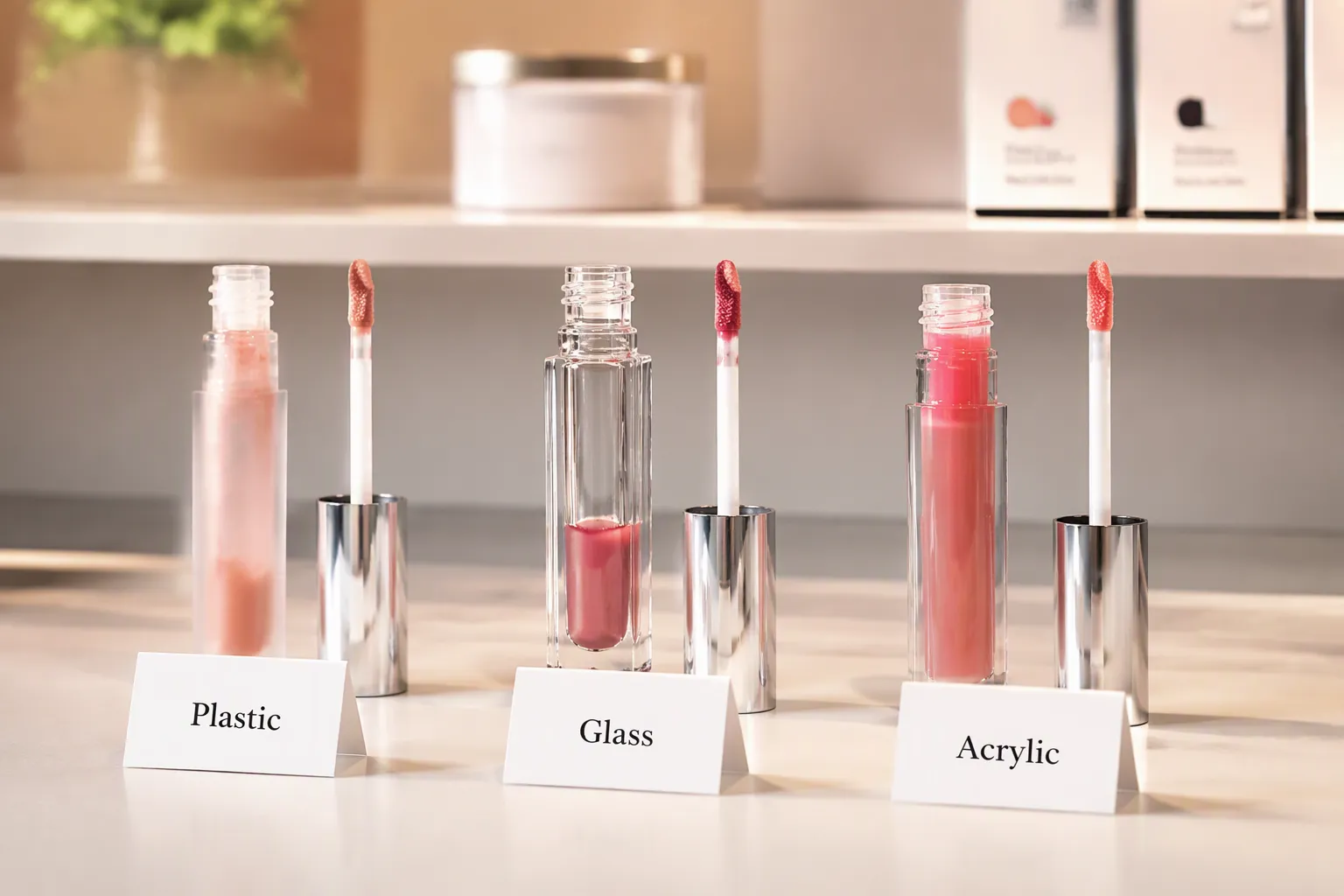
Plastic, glass, and acrylic—these materials bring different trade-offs in cost, durability, aesthetics, sustainability, and manufacturing. Glass conveys premium appeal but adds weight. Plastic resists breakage yet can scratch. Acrylic delivers similar clarity in a lighter body.
The best material depends on brand positioning, product formula, target customer, and distribution channels. View the comparison as a practical decision framework, not a one-size-fits-all final answer. Lisson helps brands explore materials and request custom packaging samples.
Key Takeaways
-
Glass looks luxurious but weighs more and costs more to ship.
-
Plastic is lightweight and shatter-resistant but may seem less premium.
-
Acrylic offers a glass-like look with less weight and more durability.
-
Test your formula with the bottle material to prevent leaks or damage.
-
Choose a material that matches your brand image and customer needs.
Plastic, Metal, and Glass: Picking a Lip Gloss Bottle Material
The phrase plastic, metal, and glass describes the broad packaging landscape. For lip gloss bottle production, however, metal plays almost no role. The practical choice narrows to plastic, glass, and acrylic.
Why Metal Is Rarely Used for Lip Gloss Bottles
Metal containers suit solid products like lip balm or pressed powder. A lip gloss bottle holds a viscous liquid or gel. Metal reacts with many cosmetic formulas, and the risk of corrosion or formula degradation is high. Metal also blocks the visual inspection that consumers expect from lip gloss tubes. Shoppers want to see the color and shimmer inside. A metal shell hides the product and weakens shelf appeal.
Metal does appear in cosmetic packaging as a decorative cap, collar, or applicator component. These parts do not contact the formula directly. The primary vessel remains plastic, metal, or glass in name only, with metal serving an accent role.
Where Acrylic Fits Between Plastic and Glass
Acrylic occupies a middle position. It delivers glass-level visual sophistication, including depth of clarity and refractive quality, at roughly half the weight of glass. The table below compares the three practical options.
|
Feature |
Acrylic |
Glass |
PET Plastic |
|---|---|---|---|
|
Appearance |
High clarity, glass-like |
Very high clarity, luxury |
High clarity, softer look |
|
Weight |
Lighter than glass |
Heaviest |
Very lightweight |
|
Shatter resistance |
Shatter-resistant |
Fragile |
Flexible, impact resistant |
While acrylic is less fragile than glass, it scratches more easily than glass and can develop surface marks over time.
Acrylic costs more than standard PET or polypropylene containers. It also scratches more readily than glass, though minor marks can sometimes be buffed out. PETG offers another path. This polymer provides light transmission exceeding 90%, closely mimicking the optical brilliance of heavy borosilicate glass without the fragility or transport weight. Unlike conventional acrylic, PETG resists crazing and shattering under drop testing. Brands weighing plastic and glass bottles should treat acrylic and PETG as serious middle-ground options.
Glass vs Plastic Cosmetic Packaging: Key Trade-Offs
Weight, Shipping, and Cost Differences
Weight drives the first major trade-off. Glass weighs roughly three times more than plastic. This difference raises shipping costs by 30% to 50% for glass compared to plastic equivalents. A 10ml glass tube costs about $0.80 to $1.20 in bulk orders of 5,000 units or more. A 10ml PETG plastic tube costs about $0.30 to $0.60 in the same volume. When shipping enters the calculation, the total cost for glass runs 50% to 70% higher than plastic. For a brand ordering 10,000 units, glass adds $5,000 to $10,000 in packaging costs alone.
Breakage compounds these expenses. Even a 2% breakage rate in cross-border shipping can erase material margin for glass. Glass requires partitioned cartons, bubble wrap, and extra labor to survive transit. Plastic resists shattering and tolerates drops, compression, and temperature changes. This durability allows denser packing and lower secondary packaging costs.
Acrylic sits between these extremes. It weighs less than glass and resists breakage better than glass. Premium acrylics can sometimes rival or exceed standard flint glass in unit price due to complex injection molding. Brands must weigh unit price against total cost of ownership.
Premium Appeal, Recyclability, and Consumer Expectations
Consumer perception shapes the second trade-off. Glass carries associations with luxury, purity, and tradition. Luxury and eco-conscious consumers often prefer glass packaging. Glass is 100% recyclable and endlessly reusable without quality loss. It supports refillable and circular packaging initiatives. These qualities align with clean-beauty brands that avoid plastic.
Plastic faces different expectations. Standard PET is viewed as mass-market and practical. Some consumers associate plastic cosmetic packaging with disposability and environmental harm. Recycling infrastructure for plastic remains inconsistent. Many plastic items end up in landfills or oceans. Yet plastic offers advantages that matter to on-the-go consumers: affordability, convenience, and shatter resistance.
Acrylic challenges the perception gap. Acrylic can mimic glass-like clarity and weight while remaining shatterproof. This material gives brands a premium look without the fragility of glass. PETG provides light transmission exceeding 90%, closely matching heavy borosilicate glass without the transport weight.
The table below summarizes the core differences between glass and plastic for cosmetic packaging.
|
Factor |
Glass |
Plastic |
|---|---|---|
|
Weight |
About 3x heavier than plastic |
Lightweight |
|
Shipping cost |
30%–50% higher than plastic |
Lower dimensional weight |
|
Breakage |
Fragile; requires protective packaging |
Shatter-resistant |
|
Recyclability |
100% recyclable without quality loss |
Limited; infrastructure varies |
|
Consumer perception |
Premium, luxury, eco-friendly |
Practical, mass-market |
Brands comparing plastic and glass bottles must decide which trade-offs matter most. A luxury brand may accept higher shipping costs for glass appeal. A travel-focused brand may choose plastic for durability and lower freight. Acrylic offers a middle path for brands seeking glass-like aesthetics with less weight and greater resilience.
Cost Drivers for Lip Gloss Bottle Materials
Unit Price vs Total Cost of Ownership
The lowest unit price rarely delivers the lowest total cost of ownership. A lip gloss bottle priced at $0.30 may cost far more by the time it reaches a warehouse. Freight, tariffs, and handling charges can add 50% to 80% of the base unit price. For China-origin goods, import duties under HTS 7010 for glass and 3923 for plastic push the effective tariff rate to roughly 35%. These landed costs shift the true expense well beyond the factory quote.
Decoration techniques also raise total expense. Screen printing, hot stamping, and UV coatings add $0.04 to $0.25 per color or pass. Custom mold investment runs from $800 to $8,000 or more. Ancillary components like droppers and brushes add further cost. Material selection must account for these hidden drivers, not just the per-unit quote.
Breakage Rates and Shipping Weight
Breakage and shipping weight reshape the cost equation. Glass weighs roughly three times more than plastic. This weight raises shipping costs by 30% to 50% compared to plastic equivalents. A 2% breakage rate in cross-border shipping can erase material margin for glass. Protective cartons, bubble wrap, and extra labor add further expense. Plastic resists shattering and tolerates drops, which allows denser packing and lower secondary packaging costs.
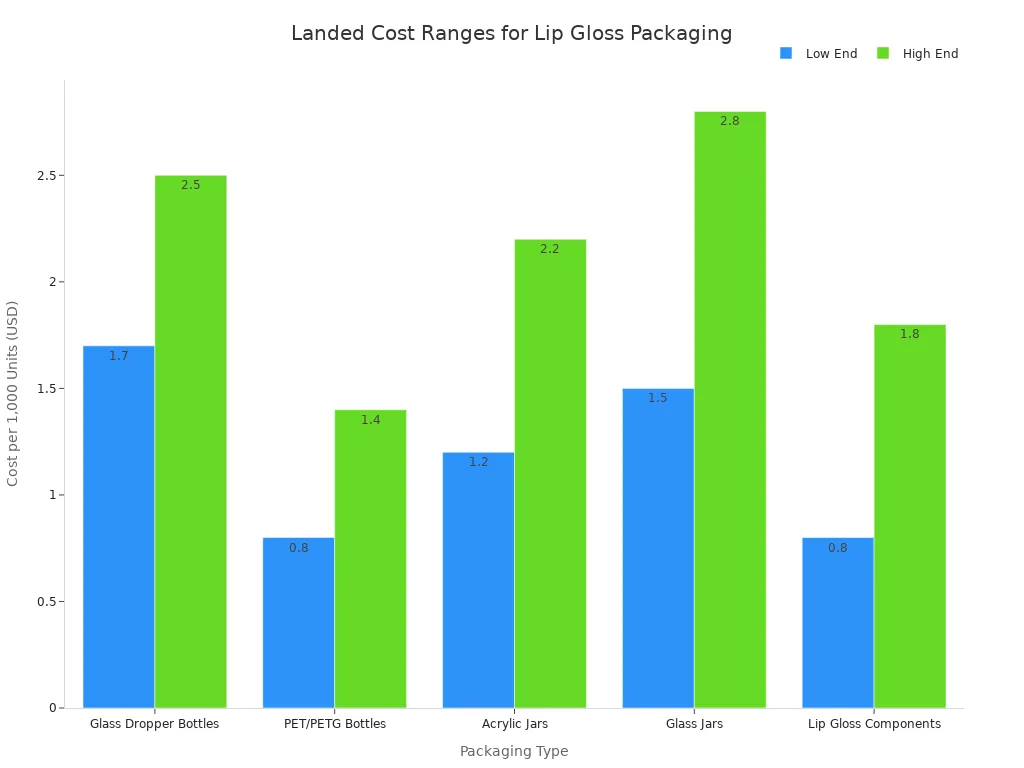
Supply chain logistics amplify these differences. Benchmark landed costs for 1,000 units from China via LCL show glass dropper bottles at $1.70 to $2.50, while PET and PETG bottles range from $0.80 to $1.40. Acrylic jars fall between at $1.20 to $2.20. Material commodity trends matter too. PET resin rose 8% to 10% year-to-date, while glass remained stable. These shifts directly affect packaging budgets across all three materials.
Durability and Product Protection for Lip Gloss Bottles
Shatter Resistance and Travel-Friendliness
A dropped bottle tells a brand everything about material performance. Plastic does not shatter the way glass does. PET resists shattering when dropped and offers good impact resistance. PP handles drops without shattering thanks to its flexible nature. PETG stands out for lip gloss packaging because it delivers a clean, transparent look with better toughness and a lower risk of cracking during handling or transport.
Acrylic behaves differently. It may crack under strong impact and lacks flexibility, so a large drop could cause fractures. Acrylic also scratches more easily than glass, and surface marks can dull its mirror finish over time. Glass provides stable material protection but remains fragile in transit and daily use. Every glass bottle shipped without partitioned cartons raises the risk of breakage during transit.
|
Material |
Shatter Resistance |
Travel-Friendliness |
|---|---|---|
|
Acrylic (PMMA) |
May crack under strong impact; less flexible |
Heavier than PET; needs robust design to withstand jostling |
|
PET |
Resists shattering if dropped; good impact resistance |
Lightweight, clear; may scuff against keys or rough surfaces |
|
PP |
Handles drops without shattering; flexible |
Suited for squeeze-tube style; less transparent than PET |
Chemical Compatibility and Formula Safety
Chemical compatibility determines whether a bottle protects its contents or slowly damages them. PET faces stress cracking from certain solvents and strong surfactants, especially at sharp corners or uneven wall thickness. Fragrance systems can cause cracking, so accelerated aging tests are recommended for corrosive ingredients. Acrylic (PMMA) shows crazing and stress whitening when alcohol and active-rich ingredients contact it. Specific fragrances can trigger the same reaction.
Glass is chemically inert and non-toxic, which protects formulas without reaction. It also blocks air, moisture, and UV. PP offers exceptional chemical resistance and works with a wide range of everyday cosmetic chemistries. Brands should test formula compatibility against the chosen material before committing to full production. Airtight systems further support preservative-light or clean beauty products. These tests reduce shipping breakage claims and protect the brand's reputation.
Aesthetics, Brand Image, and Decoration Options
Consumer Perception of Glass, Plastic, and Acrylic
Consumer surveys reveal sharp differences in perceived quality. Glass reads as premium, luxurious, and gift-worthy. Shoppers link it to product integrity and preservation despite heaviness and fragility. Plastic feels lightweight, versatile, and practical, yet it carries a less upscale connotation. Many environmentally conscious buyers associate it with disposability and ecological harm. Acrylic offers a compelling middle ground: high clarity, upscale appearance, and shatter-resistance, but buyers note its tendency to scratch and lower eco-friendliness relative to glass.
|
Material |
Perceived quality cues |
|---|---|
|
Glass |
Luxury, gifting, premium feel, product integrity; heavy and breakable |
|
Plastic |
Lightweight, shatter-resistant, versatile; less premium, eco concerns |
|
Acrylic |
High clarity, upscale appearance, durable; prone to scratching, less recyclable |
These perceptions shape material selection directly. A prestige brand accepts breakage risk for an heirloom feel. A travel-focused brand wants lighter durability. Acrylic serves brands seeking refined clarity without transport risk.
Custom Finishes, Labeling, and Printing Flexibility
Decoration success depends on surface behavior. A high-energy surface strengthens adhesive bonding and minimizes label bubbling. Clear PET or BOPP films with a permanent adhesive produce a clean no-label look. PET ranks second; its clarity and rigidity work well, though lower surface energy demands preparation before labeling. Flexible resins such as HDPE and PP require high-tack adhesives, conformable films, and sometimes corona treatment to prevent lifting. Printed colors vary by surface finish, so approve samples from the actual vessel.
Small lip gloss cylinders need thinner film, around 30 to 40 microns, paired with a high-tack permanent adhesive. This combination prevents edge lifting on tight curves, a common failure point in lip gloss packaging. The high-energy substrate labels easiest, followed by PET; flexible resins demand the most complex adhesive selection.
For brands weighing glass and plastic options, aesthetics and decoration flexibility often tip the decision. Visual experience drives first purchase intent. The printing surface determines whether brand identity survives production and daily use. This choice of materials becomes a branding decision as much as a packaging decision, so run label adhesion tests before finalizing cosmetic packaging.
Sustainability and Environmental Impact of Lip Gloss Packaging
Recyclability and Recycled Content
Material end-of-life options differ sharply across the three candidates. Glass is 100% recyclable without quality loss, and it can cycle endlessly through closed-loop systems. This quality makes glass packaging a strong fit for refill and circular models. Brands that prioritize recyclability often select glass for this reason alone.
Plastic tells a more complicated story. Recycling infrastructure for plastic in cosmetics packaging remains inconsistent. Many plastic items end up in landfills or oceans. Standard PET accepts recycled content, yet supply and quality vary by region. The advantages of plastic packaging—light weight and shatter resistance—do not offset this recyclability gap for every brand.
Acrylic sits outside most curbside programs. Its lighter weight, however, can reduce transportation emissions and shipping risks. That benefit lowers the life-cycle carbon footprint of the packaging materials a brand selects. Each material therefore trades one environmental strength for another.
Refillable Packaging and Consumer Expectations
Refillable systems reshape the sustainability conversation. Glass supports refillable and circular packaging initiatives because it withstands repeated cleaning and reuse. A durable glass bottle can serve a customer for years. This longevity aligns with clean-beauty values and reduces repeat packaging waste.
Consumer expectations push brands toward visible sustainability commitments. Shoppers increasingly ask about recyclability, recycled content, and refill options. A brand that chooses glass signals long-term material stability. A brand that chooses plastic must communicate its durability and transport efficiency clearly. Acrylic offers a middle path: glass-like clarity with less shipping weight.
No single material wins on every environmental metric. Glass leads on recyclability. Plastic leads on transport efficiency. Acrylic balances both. Brands should match the material to their sustainability story and verify claims with suppliers before publishing them.
Manufacturing Lip Gloss Bottles with Lisson
Material decisions become finished bottles only when manufacturing can deliver on the design. Lisson guides brands through custom packaging choices, material sampling, and quality control. The right materials depend on manufacturing constraints. A luxury brand may accept a heavy bottle; a travel brand may prefer plastic durability. The molding process determines shape and closure integrity.
Lead Times, MOQs, and Custom Tolerances
Lead times and MOQs vary with resin and molding route. The table below compiles indicative China-made benchmarks. These figures are not fixed. Resin prices, decoration methods, exchange rates, tooling, and shipping terms all shift final quotes.
|
Supplier scenario |
Typical MOQ (pieces) |
Typical lead time |
|---|---|---|
|
Fast-turnaround stock |
1,000–10,000 |
15–30 days |
|
Cost-efficient high-volume |
30,000–200,000 |
25–50 days |
A private-label launch could start with stock PET, PP, or AS containers at 1,000–10,000 pieces and receive bottles in 15–30 days. A brand scaling into premium packaging would choose high-volume production, with MOQs starting at 30,000 pieces and lead times of 25–50 days.
Specific custom tolerance standards for glass, plastic lip gloss bottles, and acrylic lip gloss bottles are often not published. Ask suppliers for tolerance data in quotations, confirm mold ownership, and request drawings with measurements and tolerance ranges. Precision injection molding can deliver consistent dimensions for automated filling lines. Tolerance verification should follow the selected production method.
Sampling, Customization, and Source Support
Sampling protects the brand from costly surprises. A sample verifies wiper fit, cap torque, and decoration adhesion. Lisson coordinates material sampling across custom glass bottle manufacturing, custom plastic bottle manufacturing, PET/PETG bottle production, and PE bottle production. Mold engineering for uniform wall thickness supports intricate shapes; leak-proof cap integration preserves closure security.
Production capabilities extend beyond tubes. Brands selling balms or creams can consolidate cosmetic jars in the same program. Tooling and MOQ checks determine whether unusual shapes are viable. Decoration planning keeps visual impact consistent across reorders. Packaging protection during shipping prevents damage to novelty bottles. This support applies equally to cosmetic jars, and quality checks cover cosmetic jars with the same scrutiny as tubes.
Choosing the Right Material for Your Lip Gloss Brand
No single material wins across every brand scenario. The right choice depends on formula compatibility, brand image, target market, shipping environment, and sustainability goals. A luxury label may accept the weight and fragility of glass. A startup shipping through e-commerce may prefer plastic. A masstige brand may land on acrylic for its glass-like clarity without the transport risk.
Aligning Packaging with Brand Positioning
Packaging is the first customer interaction. Eye-catching lip gloss tubes create a strong first impression and differentiate the brand on a crowded shelf. Material selection should mirror the brand's price tier and the expectations of its target buyer.
|
Material |
Brand Positioning |
Target Market Demographics |
Key Attributes Influencing Selection |
|---|---|---|---|
|
Glass |
Luxury, premium, exclusive; conveys sophistication and high value |
Affluent, discerning consumers; upscale cosmetic lines |
Weighty, clear, refined tactile feel; supports frosted or metallic accents; higher cost, fragile, heavier shipping |
|
Plastic |
Cost-effective, practical, broad consumer market; can feel less luxurious if finish is poor |
Mass-market, budget-conscious, wide demographic; startups scaling production |
Lightweight, durable, versatile molding, lower cost; PETG and PP used for lip gloss tubes; transparent for product visibility |
|
Acrylic |
High-end, glass-like premium appearance while retaining plastic benefits |
High-end jar and bottle buyers; brands seeking luxury look with durability |
Transparent, glossy, shatter-resistant; positioned for high-end jars and bottles |
Susanne Nichols, CEO of International Cosmetic Suppliers Ltd (ICS), says her company is seeing new innovation on the classic stick design in many shapes and styles for both mass market and masstige brands. She describes a bi-injected crystal base lipstick with an aluminum A-shell and PETG cover that provides a premium look and feel to a cost-efficient design.
This example shows that mass-market and masstige products can use plastic and aluminum components to achieve a premium appearance without luxury-level material costs. Higher-end beauty brands rely on visually and tactilely sophisticated packaging, such as frosted or custom-molded glass, complex multi-part closures, metallic foils, magnetic clasps, and velvet-touch coatings, to elevate perceived value. Exclusive packaging is not limited to prestige categories. Masstige and mass-market brands experiment with elegant finishes and unique ergonomics to improve differentiation and emotional connection.
Testing Material Against Formula and Delivery Needs
A material that looks right on a mood board may fail against the actual formula. Brands should validate every candidate through structured testing before committing to full production.
|
Testing Area |
Protocol |
Acceptance Criteria |
Risk Addressed |
|---|---|---|---|
|
Chemical and polymer compatibility |
12-week real-time storage at 45°C/75% RH plus 3 freeze-thaw cycles (-10°C to 45°C) |
No dimensional change, no polymer haze, weight loss under 1.0% |
Environmental stress cracking, monomer leaching, swelling |
|
Vacuum seal and anti-leakage |
Vacuum decay test (ASTM D4991) at -0.06 to -0.08 MPa for 10–15 min; 55°C inverted static oven for 14 days; -60 kPa altitude simulation |
Zero leakage, no micro-bubbles, no thread seepage |
Seal blowout, thread seepage under barometric variance |
|
Applicator and wiper mechanics |
Wand withdrawal pull force measured with tensile gauge; flocked applicator immersion at 50°C for 30 days |
Extraction force 2.0–4.5 N (target 2.2–4.0 N); no flock loss or adhesive dissolution |
Product splatter, stem pooling, bald applicator tips |
|
Surface decoration resistance |
Cross-hatch adhesion (ASTM D3359) with 3M 600 tape; bulk immersion at 40°C for 48 h; 50 cycles IPA rub; salt spray (ASTM B117) for 24 h |
100% adherence (Class 5B); no peeling, pitting, or corrosion |
Logo flaking, metallization peeling |
|
Transit simulation |
Drop impact (ASTM D5276) from 1.2 m onto concrete across 6 angles; random vibration (ISTA 2A) for 180 min; stacking and compression test |
No cracking, stem fracture, or leak paths |
E-commerce shipping breakage, internal thread loosening |
Lip gloss tube structures are tested for drop resistance, airtight sealing, and compatibility with oil-based, water-based, and hybrid gloss formulations. Production facilities comply with ISO9000, BSCI, and REACH standards. These protocols confirm whether a packaging material protects the formula through real-world conditions. Chemical compatibility testing protects both the product and the brand's reputation. A material that passes visual inspection may still fail under heat, altitude, or vibration. Brands should run these tests on every candidate before finalizing cosmetic packaging.
Choosing among glass, plastic, and acrylic is a trade-off, not a verdict. Each lip gloss bottle brings distinct strengths. Glass signals premium appeal, but glass adds weight and shipping risk. Glass remains endlessly recyclable. Plastic resists breakage and trims freight costs, though plastic may read mass-market. Acrylic sits between glass clarity and plastic resilience.
Cost, durability, aesthetics, sustainability, chemical compatibility, and manufacturing feasibility all matter. No single material selection wins every scenario. The right packaging balances these factors with your brand goals. Request samples and test materials with your own formula before committing.
For packaging guidance, samples, or a custom quote, contact Lisson.
FAQ
Which material offers the best shatter resistance for lip gloss tubes?
PET plastic resists shattering when dropped and provides good impact resistance. PETG delivers a clean, transparent look with better toughness and a lower risk of cracking during handling. Acrylic may crack under strong impact. Glass remains fragile in transit and daily use.
How does material choice affect shipping costs for cosmetic packaging?
Glass weighs roughly three times more than plastic. This weight raises shipping costs by 30% to 50% compared to plastic equivalents. Breakage compounds these expenses. Even a 2% breakage rate in cross-border shipping can erase material margin for glass. Acrylic sits between these extremes.
Can acrylic match the premium look of glass for cosmetic jars?
Acrylic delivers glass-level visual sophistication, including depth of clarity and refractive quality, at roughly half the weight of glass. PETG provides light transmission exceeding 90%, closely mimicking heavy borosilicate glass without the fragility or transport weight. Both materials offer premium aesthetics without glass fragility.
What testing should brands run before finalizing packaging materials?
Brands should validate every candidate through structured testing. Chemical and polymer compatibility tests include 12-week real-time storage at 45°C/75% RH plus freeze-thaw cycles. Vacuum seal tests check for leakage. Drop impact tests simulate transit conditions. These protocols confirm whether a material protects the formula through real-world conditions.
Are cosmetic jars made from glass more sustainable than plastic options?
Glass is 100% recyclable without quality loss and supports refillable packaging initiatives. Plastic recycling infrastructure remains inconsistent, and many items end up in landfills. Acrylic sits outside most curbside programs. Its lighter weight, however, can reduce transportation emissions. No single material wins on every environmental metric.