PE Tube vs ABL Tube vs Aluminum Tube: Which Cosmetic Tube Is Better?
Choosing a cosmetic tube is not simply a matter of comparing appearance or unit price. The material structure affects how well a package protects its formula, how easily consumers dispense the product, whether the tube works with existing filling equipment, and how much the packaging costs over its entire production cycle.
PE, ABL, and full aluminum tubes are three common options in cosmetic packaging. Each has a different structure and performs differently when exposed to oxygen, moisture, light, mechanical stress, and repeated squeezing. A tube that works well for a basic body lotion may not provide sufficient protection for an oxidation-sensitive skincare formula.
This guide compares the three structures from a formulation, manufacturing, and purchasing perspective to help cosmetic brands select packaging that meets both product requirements and commercial objectives.
Quick Answer
PE tubes are generally suitable for everyday creams, lotions, cleansers, and other formulations that do not require an exceptionally high barrier. ABL tubes combine a plastic-based structure with an aluminum barrier layer, making them a practical choice when stronger protection against oxygen, moisture, and light is required. Full aluminum tubes provide a metal barrier and can be useful for selected products that need strong protection from external exposure, but they have different deformation and dispensing characteristics.
There is no universally best material. The right choice depends on the formula's sensitivity, desired shelf life, filling process, consumer experience, decoration requirements, and target packaging cost.
Key Takeaways
- PE tubes offer flexibility, convenient squeezing, and broad customization options for everyday skincare products.
- ABL tubes incorporate an aluminum barrier layer and can provide a better balance between barrier protection and plastic-tube usability.
- Full aluminum tubes provide strong protection against light, oxygen, and moisture when the tube wall and internal coating are properly specified.
- Material compatibility must be tested with the actual formulation, not determined by the tube material name alone.
- A packaging specification should include the complete tube structure, wall thickness, closure, sealing method, and filling requirements.
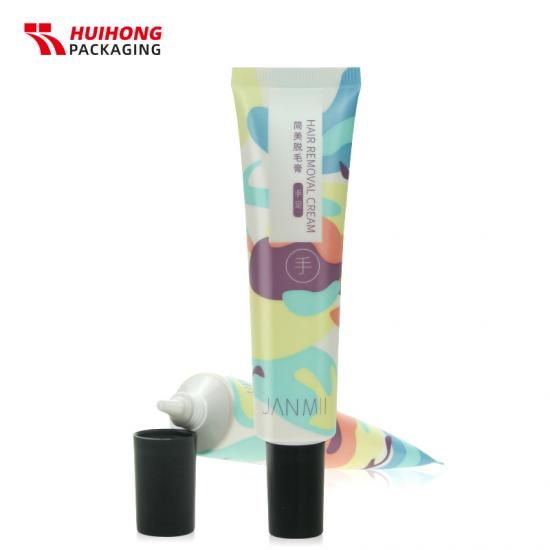
1. Understanding the Three Cosmetic Tube Structures
PE Tubes: Flexible and Versatile Plastic Packaging
PE stands for polyethylene, a thermoplastic widely used in cosmetic packaging. Depending on the design, PE tubes may use different polyethylene grades or combinations of materials to achieve the required flexibility, stiffness, and processing characteristics.
The main advantage of PE is its flexibility. Consumers can squeeze the tube to dispense cream or lotion, and the packaging can be manufactured in different diameters, lengths, colors, and shapes. It also supports common decoration methods such as offset printing, silk-screen printing, and hot stamping, subject to the selected surface and production process.
However, conventional PE is not an absolute oxygen or moisture barrier. Its permeability needs to be considered when packaging formulas containing oxidation-sensitive ingredients, fragrances, or other components that may be affected by external exposure.
For brands developing daily skincare products, a custom PE cosmetic tube packaging solution can provide a practical combination of flexible dispensing, customized appearance, and production adaptability.
ABL Tubes: Aluminum Barrier Laminates
ABL stands for Aluminum Barrier Laminate. Unlike a conventional single-material plastic tube, an ABL tube is manufactured using multiple bonded layers, including an aluminum barrier layer and polymer layers. The exact layer arrangement varies by supplier and product specification.
The aluminum layer helps reduce the transmission of oxygen, moisture, and light through the tube wall. The polymer layers provide a suitable surface for printing, support the structure, and help create a package that can be squeezed by consumers.
ABL is particularly useful when a formula needs more protection than a standard PE tube can provide, but the brand still wants a familiar plastic-tube dispensing experience. It is commonly considered for hand creams, facial creams, BB creams, and selected skincare products.
For example, Huihong Packaging lists a 30 ml ABL squeeze cream tube with a nozzle applicator. Its published specification identifies an ABL tube body and PP lid, with customized color and graphic options. The listed MOQ for this particular product is 10,000 pieces. These are product-specific details and should be reconfirmed before ordering.
Brands comparing different ABL cosmetic squeeze tube packaging options should also check the laminate's sealing performance, compatibility with the formulation, and resistance to repeated squeezing.
Full Aluminum Tubes: Metal Barrier Packaging
Full aluminum cosmetic tubes are made from metal rather than a plastic laminate structure. Aluminum provides an effective barrier against oxygen, moisture, and light through the tube wall. This can be valuable for products whose ingredients are sensitive to environmental exposure.
A key characteristic is that the tube generally retains its collapsed shape after being squeezed. This differs from many PE tubes, which tend to recover some of their original shape. The collapsed structure can also limit the amount of air returning into the tube after dispensing.
However, full aluminum tubes require careful consideration of internal lacquer or coating compatibility. Some formulations may interact with exposed metal or the internal coating. The neck, shoulder, closure, and crimped tail must also be designed to prevent leakage and maintain package integrity.
A collapsible aluminum cosmetic tube can be considered for selected creams and paste-like products, provided the internal coating and filling process are validated for the intended formula.
2. PE vs ABL vs Aluminum: Technical Comparison
The following table provides a practical comparison. Actual performance depends on material grade, wall thickness, layer construction, coating, closure design, and manufacturing quality. It should not be treated as a substitute for supplier test reports.
| Evaluation Factor | PE Tube | ABL Tube | Full Aluminum Tube |
|---|---|---|---|
| Basic structure | Polyethylene-based plastic | Polymer laminate with aluminum barrier | Aluminum metal body |
| Oxygen barrier | Limited; grade and thickness dependent | High potential barrier through the laminate wall | Very high through the intact metal wall |
| Light protection | Depends on pigment and opacity | Strong protection from aluminum layer | Strong protection through metal wall |
| Squeezing behavior | Flexible; some shape recovery | Flexible; laminate construction affects recovery | Collapses and generally retains deformation |
| Printing and decoration | Broad customization options | Good options depending on laminate and print system | Metallic appearance and specialized decoration |
| Formula compatibility | Requires polymer compatibility testing | Requires laminate and seal compatibility testing | Requires internal coating compatibility testing |
| Typical consideration | Everyday skincare and cleansers | Products requiring additional barrier protection | Selected barrier-sensitive creams and pastes |
3. Which Tube Material Is Suitable for Different Cosmetic Formulas?
Daily Moisturizers and Body Lotions
For conventional moisturizers and body lotions, PE tubes are often a sensible starting point. These products generally prioritize convenient dispensing, consumer-friendly squeezing, and cost control. A standard PE structure may be sufficient when formula compatibility and stability testing confirm that the packaging meets the product's shelf-life requirements.
For products containing sensitive oils, fragrances, or active ingredients, the brand should compare the actual permeability and compatibility data rather than assuming that every moisturizer can use the same tube.
Hand Creams and Barrier-Sensitive Formulas
Hand creams are frequently packaged in both PE and ABL tubes. ABL becomes more attractive when the product requires stronger protection from external exposure or when the brand wants an aluminum-based barrier structure without switching to a full metal tube.
The choice should also consider viscosity. A thick cream may require a larger opening or a different nozzle design to maintain comfortable dispensing. Excessive squeezing force can affect the consumer experience even when the tube material itself is suitable.
Cleansers and Paste-Like Products
Facial cleansers, cleansing creams, and toothpaste-like products often need a package that can dispense a controlled quantity without excessive effort. PE and laminate tubes are both possible options. Full aluminum tubes may also be considered for compatible formulations, particularly when a metal barrier and collapsible dispensing behavior are desired.
The formulation's particle content, viscosity, pH, and interaction with the internal packaging surface should be evaluated before finalizing the design.
Sensitive and High-Value Skincare Products
Products containing oxidation-sensitive ingredients may need a higher-barrier structure. ABL or full aluminum packaging can be evaluated, but the tube body is only one part of the protection system. The closure, shoulder, neck, tail seal, and filling process can all influence the final package performance.
For especially sensitive formulas, brands should also consider airless dispensing systems where appropriate. A high-barrier tube does not automatically provide the same protection as a properly designed airless package.
4. Five Technical Checks Before Selecting a Cosmetic Tube
1. Formula Compatibility
Check the formula's pH, oil content, solvents, surfactants, fragrance components, and active ingredients. These factors can influence polymer compatibility, coating integrity, migration, odor, and product stability. Conduct compatibility testing using the actual formulation and production-representative packaging.
2. Oxygen and Moisture Transmission
Ask suppliers for oxygen transmission rate (OTR) and water vapor transmission rate (WVTR) data where relevant. Always check the test method, temperature, relative humidity, specimen thickness, and unit. For example, oxygen transmission data measured under ASTM D3985 should not be directly compared with results obtained under different conditions without considering the testing basis.
Also clarify whether the reported result refers to the flat tube material or the complete package. A strong barrier wall cannot compensate for a poorly sealed closure or defective tail seal.
3. Filling and Sealing Compatibility
Different tube constructions may require different filling and sealing parameters. Confirm tube diameter, length, opening dimensions, tail-sealing method, filling temperature, and machine compatibility. A new tube design should be tested on the actual filling line before mass production.
4. Consumer Dispensing Experience
Test how much force is needed to dispense the product, whether the opening becomes blocked, and whether the tube leaks after repeated use. A thick cream, liquid serum, and facial cleanser may need different nozzle or orifice designs even if they share the same tube material.
5. Decoration and Sustainability Requirements
Decoration should be assessed alongside the material structure. Printing adhesion, color consistency, scratch resistance, and surface treatment should be checked on production samples. For sustainability claims, verify the actual material composition and the availability of collection and recycling infrastructure in the target market. A laminate containing aluminum and polymer layers should not automatically be described as widely recyclable.
5. Manufacturing Example: Turning a Tube Specification into a Production Order
Huihong Packaging, established in 1996, is a cosmetic packaging manufacturer based in Foshan, China. Its published company information describes capabilities covering mold development, injection molding, printing, assembly, and inspection. Its product range includes PE tubes, ABL tubes, aluminum tubes, sunscreen packaging, and functional applicator packaging.
Two published products illustrate how different structures can be matched to different packaging requirements:
| Product Example | Published Specification |
|---|---|
| 30 ml PE Body Lotion Tube | PE tube body, PP lid/cap, oval screw design, customized logo and graphics, listed MOQ of 10,000 pieces. |
| 30 ml ABL Cream Tube | ABL tube body, PP lid/cap, nozzle applicator, customized color and graphics, listed MOQ of 10,000 pieces. |
| Full Aluminum Collapsible Tube | Published aluminum tube product with screw-top closure; final coating and formula compatibility need project-specific confirmation. |
These examples show why packaging selection should begin with the product requirement rather than a fixed preference for one material. A PE tube can be appropriate for a conventional lotion, while an ABL design may be more suitable when the formula requires an additional barrier layer.
For a new project, a practical development process is to confirm the formula and target capacity, select a preliminary tube structure, review samples, perform compatibility and leakage tests, verify filling-line performance, and approve a signed production sample before ordering.
The MOQ and lead time should always be reconfirmed against the selected design, printing requirements, and current production schedule. Published specifications for one product should not be assumed to apply to every customized tube.
6. Frequently Asked Questions
Is ABL better than PE for cosmetic packaging?
Not in every application. ABL generally offers a stronger barrier through its aluminum layer, while PE offers a simpler plastic structure and flexible dispensing. For ordinary lotions, PE may be sufficient. For formulas requiring additional protection, ABL is worth evaluating.
Are aluminum tubes suitable for all skincare products?
No. The internal coating must be compatible with the formulation. Product pH, solvents, oils, and active ingredients can affect the interaction between the formula and the tube's internal surface. Compatibility testing is essential.
Which cosmetic tube is the most cost-effective?
PE is often a practical starting point for cost-sensitive, conventional skincare products. However, the actual cost depends on tube dimensions, material grade, decoration, order volume, tooling, and filling requirements. A lower unit price is not necessarily the lowest total packaging cost if the structure causes product stability or production problems.
Can ABL tubes be customized with different shapes and applicators?
Customization options depend on the supplier's tooling and laminate processing capabilities. Tube diameter, capacity, printing, cap design, and certain applicator configurations can be developed for different projects. The finished design must be checked for sealing and dispensing performance.
What tests should be completed before mass production?
At minimum, consider formula compatibility, leakage, closure fit, tail-seal integrity, dispensing performance, appearance, and transport simulation. For barrier-sensitive products, request relevant OTR and WVTR data and conduct stability testing using the complete package.
How do I choose the right cosmetic tube manufacturer?
Evaluate the supplier's material options, technical documentation, sample development process, customization capabilities, quality inspection procedures, and ability to maintain consistency across production batches. A reliable manufacturer should be able to explain the structure of the proposed tube and provide samples for testing before mass production.
For customized PE, ABL, or aluminum cosmetic tube projects, Huihong Packaging can be contacted to discuss material selection, tube dimensions, printing, applicator options, and sample development.