Custom paper canisters have become a practical packaging option for brands that need distinctive cylindrical packaging, flexible printing, and product-specific protection. They are widely used for tea, coffee, powdered foods, snacks, cosmetics, supplements, incense, and gift products. For wholesalers, importers, and private-label brands, sourcing the right paper canister involves more than comparing unit prices. Material structure, inner lining, sealing performance, dimensions, printing quality, minimum order quantity, and production consistency all affect the final result.
When sourcing custom paper canisters wholesale, buyers should first define what the container needs to protect and how customers will use it. A paper tube for gift packaging has different requirements from a sealed paper canister for matcha powder or coffee. The right supplier should be able to explain these differences and recommend a suitable structure rather than offering one standard design for every product.
Xiamen SengKen Industry & Trade Co., Ltd. provides customized paper tube and paper canister packaging for food, tea, cosmetics, gifts, and other applications. Its product range includes rolled-edge paper tubes, unsealed paper cans, airtight paper canisters, and shaker-lid paper tubes, with customization options for size, material, printing, and internal lining.
What Should You Look for When Sourcing Custom Paper Canisters Wholesale?
A reliable wholesale paper canister supplier should be able to support the complete packaging specification, from the outer paper material to the lid, inner barrier, printing, and final dimensions. Before requesting quotations, evaluate these core factors:
- Material structure: Confirm the paper grade, wall construction, inner lining, and lid materials.
- Product protection: Determine whether the packaging needs moisture resistance, aroma retention, light protection, or airtight sealing.
- Size and capacity: Match the canister diameter and height to the actual product weight, volume, and filling method.
- Closure design: Select a lid or sealing structure that supports the required opening experience and storage conditions.
- Printing and branding: Check available printing methods, color matching, logo reproduction, and surface finishes.
- Food-contact suitability: For food packaging, verify the complete material structure and relevant compliance documentation.
- Wholesale terms: Confirm MOQ, sampling costs, production lead time, packaging method, and shipping arrangements.
- Quality consistency: Evaluate whether the supplier can maintain dimensions, sealing performance, printing quality, and appearance across repeat orders.
The most suitable supplier is not necessarily the one offering the lowest initial price. It is the one that can match the packaging structure to the product, communicate technical limitations clearly, and maintain consistent quality from sampling to mass production.

Kraft paper canisters with customized cylindrical packaging and printed branding.
Choose the Right Paper Canister Material and Structure
Paper canisters are not all made with the same material construction. The outer paper layer provides the visible branding surface and structural support, while the inner layer determines how the packaging interacts with the product. Buyers should select the material structure according to the product's storage requirements, rather than assuming that every paper canister provides the same barrier performance.
Kraft Paper Construction
Kraft paper is commonly used for cylindrical packaging because of its natural appearance and suitability for printed or wrapped paper surfaces. It is a practical option for gift packaging, dry goods, incense, accessories, and products where a kraft-style appearance supports the brand identity.
However, kraft paper alone should not be treated as an airtight or moisture-proof barrier. If the packaged product is sensitive to humidity, oxygen, or external odors, the supplier should recommend an appropriate inner liner or composite structure.
Composite Paper Canisters
Composite paper canisters combine paper-based outer layers with additional functional materials. Depending on the design, the inner wall may include aluminum foil, coated paper, or other barrier materials. This construction can help improve protection against moisture, air, light, and odor transfer when the materials and sealing system are correctly specified.
For powdered foods and products that require a more controlled storage environment, a composite structure is often more suitable than a simple paper tube. SengKen's Good Airtight Paper Canister range includes composite paper cans with aluminum foil easy-peel lids, paper cans with easy-open ends, and paper tubes with pry-off caps.
Food-Grade Inner Linings
For tea, coffee, matcha, spices, nutritional powders, and other food products, the inner lining is an important part of the packaging specification. Food-contact suitability should be evaluated for every material layer that may contact the packaged product, including liners, seals, lids, and coatings.
Buyers should request relevant food-contact documentation for the intended destination market and product application. A supplier's general statement that a paper canister is food grade should not replace verification of the actual material composition and applicable test reports.
Reinforced Paper Tube Walls
Wall thickness and paper construction affect the rigidity of a cylindrical container. A thicker or reinforced structure may be appropriate when the package needs to support heavier contents, withstand stacking, or maintain its shape during handling and transportation.
For products that mainly need a simple cylindrical outer package, explore Cylinder Paper Tube Packaging to compare different paper tube structures and customization possibilities.
Evaluate Sealing Performance and Lid Options
The closure is one of the most important decisions when sourcing wholesale paper canisters. It affects product protection, opening convenience, resealing, filling operations, and the overall customer experience.
Easy-Peel Aluminum Foil Lids
Easy-peel foil lids are commonly used for composite paper canisters designed for powdered foods and other products that require a sealed inner closure. When properly matched with the canister opening, the foil membrane can help limit moisture and air exposure before the package is first opened.
This structure is particularly relevant for matcha powder, tea powder, coffee powder, and selected dry food products. SengKen's Matcha Powder Paper Can with Aluminum Foil Easy-Pull Lid combines a kraft paper and aluminum foil composite structure with an easy-pull inner lid and a food-grade PP outer cover.
Metal Lids
Metal lids are used in some tea and coffee paper canisters to provide a firm closure and a distinctive packaging appearance. Depending on the design, they may be paired with an inner sealing membrane or another closure component.
When evaluating a metal-lid paper canister, check the fit between the lid and the canister body, the presence of an inner seal, and whether the closure meets the product's storage requirements. A metal lid by itself does not automatically make a container airtight.
Plastic Lids
Plastic lids are available in different shapes and opening styles. They can be used for reusable outer closures, easy-access packaging, and products that need repeated opening and closing. The lid material should be compatible with the product and the intended market requirements.
Shaker Lids and Dispensing Closures
Shaker lids are useful for products that need controlled dispensing, such as salt, spices, seasoning powders, and selected dry ingredients. The opening design should match the particle size and dispensing behavior of the contents.
For applications where consumers need to pour or sprinkle the contents, compare the available Shaker Lid Paper Tube options and confirm whether the closure can be integrated with the required inner barrier.
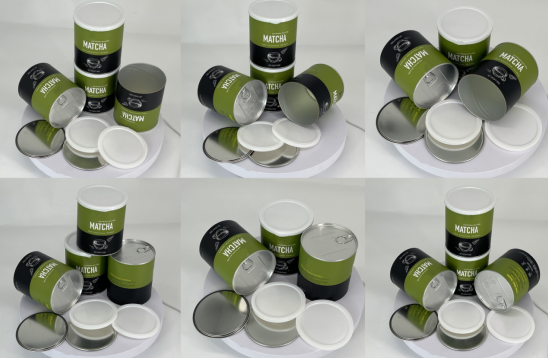
Composite powder packaging with inner sealing lids and reusable outer covers.
Check Dimensions, Capacity, and Product Compatibility
Incorrect dimensions can create problems during filling, sealing, storage, and retail display. A paper canister may look suitable in a product photograph but still be unsuitable for the actual contents or production line.
When specifying dimensions, buyers should provide the required diameter, height, internal volume, and target filling weight. The relationship between these measurements depends on the product's density and how it settles inside the container.
For example, a canister designed for loose-leaf tea may need a different internal volume from one intended for finely ground coffee or matcha powder, even if the net weight is similar.
Check the following details before approving a sample:
- Inner diameter: Confirm that the product can be filled easily and removed without difficulty.
- Overall height: Allow enough space for the contents, inner closure, and outer lid.
- Wall thickness: Consider rigidity, stacking, handling, and transportation requirements.
- Internal usable volume: Check the actual filling capacity rather than relying only on external dimensions.
- Lid fit: Confirm that the lid can be installed and removed as intended without excessive looseness or force.
- Filling compatibility: Check whether the canister is suitable for manual filling, semi-automatic filling, or the customer's existing production equipment.
For reference, SengKen's matcha powder paper can product page lists a conventional size of 73 mm in diameter and 120 mm in height, with a stated standard capacity of 250 g. This is a product-specific reference, not a universal size recommendation. Actual capacity should be tested using the buyer's own product.
Assess Printing Quality and Custom Branding Options
Custom printing is one of the main reasons brands choose paper canisters. A cylindrical package provides a large printable surface for logos, product information, brand stories, illustrations, and decorative patterns. The printing method and finishing process should be selected according to the artwork, order quantity, and desired appearance.
CMYK and Spot Color Printing
CMYK printing is suitable for full-color artwork, product photography, and designs with multiple color variations. Spot color printing can be considered when brand colors need more controlled reproduction. Buyers should provide clear artwork files and confirm color expectations with a physical sample or approved color reference.
Hot Foil Stamping
Hot foil stamping adds metallic or specialty foil details to selected areas of the packaging. It is often used for premium tea, cosmetics, gift packaging, and seasonal products where a more decorative appearance is important.
Embossing and Debossing
Embossing raises selected design elements, while debossing presses them into the surface. These techniques can add tactile detail to a logo or decorative pattern and help create a more distinctive branded package.
Matte and Gloss Finishes
Matte lamination creates a softer, less reflective appearance, while gloss lamination provides a brighter surface. Varnishing and spot UV can also be used to emphasize selected areas of a design.
Before mass production, ask the supplier to confirm which printing and finishing methods are compatible with the selected paper material and canister construction. SengKen supports printing and finishing options including four-color printing, spot colors, hot stamping, embossing, UV coating, and matte or gloss lamination.

Custom-colored cylindrical paper canisters with printed decorative details.
Consider the Intended Application Before Choosing a Paper Canister
The same paper canister design does not necessarily work for every product. Packaging requirements change according to the contents, storage conditions, retail environment, and consumer usage.
Tea and Coffee Packaging
Tea and coffee brands often need packaging that protects aroma and helps control moisture exposure. Depending on the product, a composite inner liner, foil seal, metal lid, or other closure system may be required. The canister should also provide enough space for the product and any inner bag or protective pouch.
For tea brands seeking a cylindrical retail package, SengKen offers Tea Paper Cans with Sealed Metal Lids, which are designed for black tea and green tea packaging.
Powdered Food and Ingredients
Matcha, protein powders, baking ingredients, spices, and other powdered products may need an inner barrier to reduce exposure to moisture, air, and light. The correct structure depends on the product's sensitivity and shelf-life requirements. Buyers should test the complete package with the actual contents before approving large-volume orders.
Snack and Dry Food Packaging
Chips, nuts, dried fruit, biscuits, and other dry snacks may use paper canisters with plastic lids, foil seals, or composite barriers. The container should provide sufficient rigidity and suitable internal protection for the product's handling and distribution conditions.
Cosmetics and Personal Care Packaging
Paper canisters can be used for selected cosmetic products, gift sets, bath products, and fragrance-related items. In these applications, appearance, fit, surface finish, and compatibility with the product are important. If the contents require direct contact with an inner container, that component should be evaluated separately.
Gift and Promotional Packaging
For gift packaging, presentation may be the primary requirement. Kraft paper, specialty paper, custom printing, foil stamping, embossing, ribbons, and decorative lids can help create a distinctive appearance. Depending on the product, the canister may also include an insert to hold the contents in place.
Incense and Fragrance Products
Incense sticks and fragrance-related products may require packaging that protects the contents from physical damage and helps retain their intended presentation. The closure and inner material should be selected according to the product's fragrance and storage needs.
Verify Food Safety, Barrier Performance, and Quality Requirements
For food-related paper canisters, material selection and product testing should be treated as essential purchasing steps. The phrase "food grade" alone does not explain which layers are suitable for direct food contact or what performance the finished package can provide.
Before placing a wholesale order, ask the supplier to clarify:
- Which material layers are intended for direct food contact.
- Whether the inner liner, lid, adhesive, coating, and sealing membrane are suitable for the intended food application.
- Which food-contact test reports or compliance documents are available for the destination market.
- Whether the packaging has been evaluated for moisture, oxygen, light, or aroma barrier requirements.
- Whether the closure has been tested for leakage, lid fit, and sealing consistency.
- How product quality is checked during production and before shipment.
Barrier performance should be defined according to the product's actual shelf-life requirements. A paper canister with an aluminum foil liner may provide useful protection, but the complete package performance also depends on the lid, sealing interface, manufacturing quality, and filling process.
For this reason, buyers should request samples and conduct suitable product-specific tests. If the packaged goods are sensitive to oxygen or moisture, discuss the required barrier performance with the supplier rather than relying on a general description such as "airtight" or "moisture-proof."
Compare MOQ, Sampling, Lead Time, and Wholesale Pricing
Wholesale purchasing decisions should consider the total project cost, not only the quoted price per canister. A lower unit price may involve a higher minimum order quantity, fewer customization options, longer lead times, or additional charges for tooling and printing setup.
Minimum Order Quantity
MOQ varies according to the canister structure, material, printing process, lid type, and customization requirements. SengKen's matcha powder paper can product page lists an MOQ of 500 pieces, while another customized round paper canister product lists 1,000 pieces. These are product-specific examples, not a universal MOQ for every paper canister.
When comparing suppliers, ask whether the MOQ applies to each size, color, artwork design, or total order quantity. This is particularly important for brands that need multiple SKUs.
Sample Development
A pre-production sample helps buyers check the physical dimensions, lid fit, material appearance, printing colors, and overall construction. For food packaging, the sample should also be evaluated with the actual product whenever practical.
Confirm whether sample charges, shipping costs, and any tooling fees are included in the quotation. Also ask whether the approved sample will be used as the reference standard for mass production.
Production Lead Time
Production lead time depends on order quantity, material availability, printing complexity, finishing processes, and sample approval. Buyers should request a realistic production schedule that includes artwork confirmation, sampling, mass production, inspection, and shipment preparation.
Wholesale Price Structure
Request a quotation that clearly identifies the canister size, material structure, lid type, printing method, surface finish, order quantity, and shipping terms. This makes it easier to compare quotations from different suppliers on an equivalent basis.
For repeat orders, discuss how material specifications, approved artwork, and sample standards will be retained to support consistency between production batches.
How to Evaluate a Custom Paper Canister Manufacturer
A capable paper canister manufacturer should understand both packaging design and production requirements. Buyers should look beyond product photographs and evaluate whether the supplier can support the project from initial specification to repeat orders.
Product Range and Manufacturing Experience
Check whether the supplier manufactures the paper canister structures relevant to your application, such as rolled-edge paper tubes, composite paper cans, sealed canisters, and shaker-lid packaging. A broader product range can make it easier to compare alternative structures within the same supplier relationship.
Customization Capability
Ask whether the supplier can adjust diameter, height, wall construction, inner lining, lid design, printing, and surface finishing. For non-standard packaging, provide drawings, reference samples, or detailed product requirements.
Quality Control
Discuss how the manufacturer checks dimensions, roundness, lid fit, printing appearance, surface defects, and sealing performance. For food-related packaging, also clarify the available material documentation and product testing process.
Communication and Project Management
Clear communication is especially important for customized packaging. The supplier should be able to confirm technical details, explain material limitations, provide sample feedback, and communicate production progress before shipment.
Xiamen SengKen Industry & Trade Co., Ltd. states that it has more than 20 years of experience in packaging printing and manufacturing, and provides customized cylindrical paper tube packaging, including rolled-edge paper tubes, unsealed paper cans, airtight paper canisters, and shaker-lid paper tubes. Its customization scope includes size, material, printing, inner lining, and logo graphics.

Printed cylindrical paper tubes for branded product and gift packaging.
A Practical Checklist Before Placing a Wholesale Paper Canister Order
Before confirming a custom paper canister order, use the following checklist to make sure the most important specifications have been agreed upon:
- Define the product type, net weight, and intended packaging application.
- Confirm the canister diameter, height, wall thickness, and internal capacity.
- Select the outer paper material and inner liner structure.
- Choose the lid type and specify whether an inner seal is required.
- Confirm food-contact suitability and request relevant documentation when applicable.
- Specify printing artwork, color references, and surface finishing requirements.
- Request a physical sample and check dimensions, appearance, and closure fit.
- Confirm MOQ, sample charges, tooling costs, and wholesale price conditions.
- Agree on production lead time, inspection requirements, and shipping arrangements.
- Keep an approved sample and written specification for repeat orders.
A clear specification reduces misunderstandings and helps the supplier provide a more accurate quotation. It also makes it easier to compare different packaging structures before committing to mass production.
Source Custom Paper Canisters Wholesale from SengKen
Choosing a wholesale paper canister supplier is a balance between product protection, packaging appearance, customization flexibility, and production reliability. The right solution depends on the product being packaged, the required barrier performance, the target market, and the brand's budget.
SengKen provides customized cylindrical paper packaging for tea, coffee, powdered foods, snacks, cosmetics, incense, gifts, and other applications. Its product range includes kraft paper tubes, rolled-edge paper cans, composite paper canisters, sealed paper cans, and shaker-lid paper tubes.
Buyers can discuss custom dimensions, paper materials, inner liners, closure structures, logo printing, and surface finishing according to their packaging requirements. For projects that require food-contact materials or enhanced barrier performance, providing the product type and storage requirements helps the team evaluate a more suitable construction.
Whether you are developing a new private-label product or sourcing packaging for an established brand, sharing your specifications early can make sampling, quotation, and production planning more efficient.
Contact SengKen for Custom Paper Canister Wholesale Solutions to discuss your packaging design, order quantity, and customization requirements.
Frequently Asked Questions About Sourcing Custom Paper Canisters Wholesale
What should I look for when sourcing custom paper canisters wholesale?
Evaluate material structure, inner lining, sealing performance, dimensions, lid design, printing options, food-contact suitability, MOQ, sampling, lead time, and quality control. The supplier should be able to match the canister construction to the product's storage and usage requirements.
What materials are used to make custom paper canisters?
Common materials include kraft paper, white cardboard, specialty paper, and composite paper structures. Depending on the application, the inner layer may use aluminum foil, coated paper, or other functional liners. The selected structure should match the product's protection requirements.
Are paper canisters suitable for food packaging?
Yes, paper canisters can be designed for food packaging when the complete material structure is suitable for the intended food-contact application. Buyers should verify the inner liner, lid, adhesive, coating, and relevant compliance documents for the destination market.
Can paper canisters protect products from moisture and air?
Some composite paper canisters use aluminum foil liners and sealed closures to help reduce exposure to moisture and air. Actual barrier performance depends on the complete package structure, lid, sealing interface, and manufacturing quality. Product-specific testing is recommended.
What is the difference between a standard paper tube and an airtight paper canister?
A standard paper tube is generally used for cylindrical packaging and presentation, while an airtight paper canister uses additional sealing components or barrier layers to provide improved product protection. The correct choice depends on whether the contents require moisture, air, or aroma protection.
Can I customize the size and capacity of wholesale paper canisters?
Yes. Custom paper canisters can be developed with different diameters, heights, wall structures, and capacities. Buyers should provide the product type, target filling weight, and preferred dimensions so the supplier can recommend a suitable internal volume.
What printing options are available for custom paper canisters?
Common options include CMYK printing, spot color printing, hot foil stamping, embossing, debossing, UV coating, and matte or gloss lamination. The available methods depend on the selected paper material, design, and production requirements.
What is the typical MOQ for custom paper canisters?
MOQ depends on the product structure, dimensions, printing requirements, and customization level. SengKen's matcha powder paper can product page lists an MOQ of 500 pieces, while another customized paper canister product lists 1,000 pieces. Buyers should confirm the MOQ for their specific design and order quantity.
How long does it take to produce custom paper canisters?
Lead time depends on sample approval, material availability, printing and finishing processes, and order quantity. Request a project-specific schedule covering sampling, mass production, quality inspection, and shipment preparation.
What information should I provide when requesting a paper canister quotation?
Provide the product type, target capacity, diameter, height, material preference, inner liner, lid style, printing artwork, surface finish, order quantity, destination market, and any food-contact or barrier requirements. A reference sample or technical drawing can also help clarify the specification.
Can SengKen provide custom paper canisters for tea, coffee, and powdered foods?
Yes. SengKen offers customized cylindrical paper packaging for tea, coffee, matcha powder, and other food-related applications. Available structures include composite paper cans, foil-lined paper canisters, and different lid and sealing options. Buyers should confirm the required material and food-contact documentation for their specific application.
When sourcing custom paper canisters wholesale, a well-defined specification is the foundation of a successful order. By confirming material structure, sealing requirements, dimensions, printing, and production terms before sampling, buyers can select packaging that supports both product protection and brand presentation.